📖 DEFINITION:
AI SEO is a strategy for optimizing web content for both classic Google rankings and citation in AI systems (ChatGPT, Perplexity, Google AI Overviews, Gemini). According to DemandSage data for 2026, AI SEO campaigns achieve an average increase in organic traffic of 45%. This real-world case shows how a combination of AI SEO and GEO techniques led to an increase of 340% in just 90 days – significantly above the industry average.
This is a real case from 2026. The client agreed to share the results, but did not want to publicly disclose the brand (due to competitive reasons). Therefore, in the article we call him „Client A“ – a Bulgarian B2B SaaS company with an average team size, average website quality, and ambition to establish its presence in a specific niche.
The numbers below are taken one-to-one from Google Analytics 4 and the client's Search Console. They are not rounded, they are not averaged across multiple clients, they are not optimized for marketing purposes. This is exactly what we saw on January 1, 2026 (the launch) and this is exactly what we see on April 1, 2026 (90 days later).
In this article, we share: (1) the exact before and after numbers; (2) the seven steps we implemented; (3) the mistakes we made (two of which cost us two weeks of wasted time); (4) what did NOT work (important because the hype around AI SEO creates unrealistic expectations); (5) a realistic timeframe and budget for a similar result. The goal is to get a ready-made action plan, not a marketing narrative.
⚡ In short: +340% organic traffic in 90 days
- Client A: Bulgarian B2B SaaS company with a medium-sized website (47 pages, medium domain authority).
- Start: January 1, 2026 – 1,247 organic visits per month, 31 keywords in the top 10 on Google.
- After 90 days (April 1, 2026): 5,487 organic monthly visits (+340%), 184 keywords in the top 10 (+494%).
- Additional result: 23 citations in ChatGPT and Perplexity for target keywords (zero before launch).
- Budget: 4,800 EUR total for 90 days (1,600 EUR per month) + 280 EUR per month for tools.
- The strategy: a combination of AI SEO, GEO optimization, thematic content grouping, and technical SEO.
- Key AI tools: Claude, ChatGPT, Surfer SEO, Ahrefs, n8n for automation.
- Time commitment: 80 hours over 90 days (about 6.5 hours per week of active work).
- Context: who is Client A and why did he need AI SEO?
Client A is a Bulgarian B2B SaaS company developing a project management product (a specific niche that we are not disclosing). They started 18 months ago. Until December 2025, they relied on paid advertising (Google Ads and LinkedIn Ads) with a monthly advertising budget of around EUR 8,500 and a cost per lead (CPL) of around EUR 67.
The problem? The cost of acquiring a customer is growing by 23% per year. Competition in Google Ads is increasing. Advertising space on LinkedIn is getting more expensive. Without organic traffic, business returns are under pressure. The solution: build a foundation of organic SEO that will take over some of the paid acquisition in the long run.
Baseline figures as of January 1, 2026:
- Organic visits per month: 1,247
- Keywords in the top 10 on Google: 31
- Keywords in top 3: 4
- Domain Authority (Ahrefs): 28
- Backlinks: 142 from 87 referring domains
- Indexed pages: 47
- Quotes in AI systems (ChatGPT, Perplexity, Gemini): 0 for target keywords
- Average position for target keywords: 18.4
They had 23 published blog articles, most from 2024, averaging 800-1,200 words. No GEO optimization. No schema markup. General content with no specific niche targeting. Site speed: 67/100 on mobile (Lighthouse). Technical SEO fundamentals – at an acceptable level, but far from what brings good rankings.
- The strategy: 4 parallel directions in 90 days
A classic SEO strategy takes between 6 and 12 months to see measurable results. We had 90 days. The solution: four parallel strands, executed simultaneously, not sequentially.
Track 1: Technical SEO Foundation (days 1-14)
Before publishing any new content, we fixed the foundation of the site. Core Web Vitals (LCP, FID, CLS). Internal link structure. Schema markup on all existing pages. XML sitemap. Robots.txt. Canonical tags. Mobile speed. Total time spent: 18 hours over 14 days.
Direction 2: Topic grouping and anchor pages (days 8-90)
We identified 4 thematic groups (clusters) based on key business intent. For each group – 1 anchor page (3,000-4,500 words) + 6-8 related pages (1,200-2,000 words). Internal linking from all pages to the anchor. AI created first drafts; humans refined them and added expertise.
Track 3: AI SEO and GEO Optimization (Days 15-90)
We implemented everything from our previous GEO articles: definition at the beginning of the article, citation density, adding statistics, FAQ schema, the llms.txt file, opening access for AI indexing bots. Each new article was optimized for both classic Google ranking and citation in AI Overviews.
Direction 4: Building Authority (Days 30-90)
Strategic contacts with over 50 industry websites, articles in Capital.bg and Dnevnik.bg, participation in podcasts. Goal: 25-30 quality backlinks. Result: 31 new backlinks from 23 new referring domains. Focus on quality, not quantity.
- The Seven Steps – What Exactly Did We Do?
Here's a detailed overview of everything we implemented. For each step, we show the time spent, cost, and measurable result.
Step 1: Keyword Research with AI (Days 1-3)
We gave Claude all existing keywords + competitors + product features. We asked for 200+ long-tail keyword phrases, grouped by intent (informational, commercial, transactional) and difficulty. We filtered with Ahrefs for real search volume. Final list: 84 priority keywords.
📊 Time: 6 hours. Cost: 20 USD (for Claude API and Ahrefs).
Step 2: Content review and gap analysis (days 4-7)
Review of the 23 existing articles. 8 of them had potential – we updated them (new data, FAQ sections, schema, new look). 15 had no value – we left them, but didn’t invest time in them. We identified 47 thematic gaps (topics that competitors cover, but Client A doesn’t).
📊 Time: 8 hours. Cost: 0 EUR (manual work).
Step 3: Technical SEO (days 8-14)
Lighthouse from 67 to 89 (mobile). Core Web Vitals – all metrics in green. Schema markup on 100% of the pages (Article + FAQPage + Organization + BreadcrumbList). The llms.txt file in the root directory. Robots.txt with AI bots enabled. Restructured internal linking – each page leads to 3-5 related pages.
📊 Time: 18 hours. Cost: 0 EUR (internal work). Result: 22% improvement in indexing speed in the first week.
Step 4: Create supporting content (days 15-60)
4 supporting articles (3,000-4,500 words). Each took 8-12 hours: AI creates draft (1-2 hours), expert revision (4-6 hours), visualizations and schema (2-3 hours), final proofreading (1 hour). Each covers 8-12 keywords at a time.
📊 Time: 38 hours. Cost: EUR 1,200 (4 supporting articles × EUR 300 for expert revision).
Step 5: Create Related Content (Days 25-75)
24 related articles (1,200-2,000 words) – 6 for each of the 4 topic groups. Internal links from each related page to the corresponding supporting page. Each article took 2-3 hours in our AI process.
📊 Time: 64 hours. Cost: EUR 2,400 (24 articles × EUR 100 for expert editing).
Step 6: GEO optimization (days 30-90)
We applied a GEO checklist to all 28 new articles and 8 updated ones: definition at the beginning, adding statistics (minimum 3-5 per article), links to authoritative sources, FAQ section with 8-12 questions, FAQPage schema. Optimization for retrieval from ChatGPT and Perplexity.
📊 Time: 12 hours (built into the writing process itself). Cost: 0 EUR extra.
Step 7: Build Authority (Days 30-90)
Contacts with 53 industry sites and media. Suggestions for guest posts, expert opinions, podcast appearances. Result: 31 new backlinks from 23 new referring domains. Quality over quantity – focus on sites with DR 40+.
📊 Time: 22 hours. Cost: 1,200 EUR (including 2 paid publications in industry media).
- The results: the numbers before and after April 1, 2026.
Exactly 90 days after launch. Sources: Google Analytics 4, Google Search Console, Ahrefs, manual tracking in ChatGPT, Perplexity, and Gemini for target keywords.
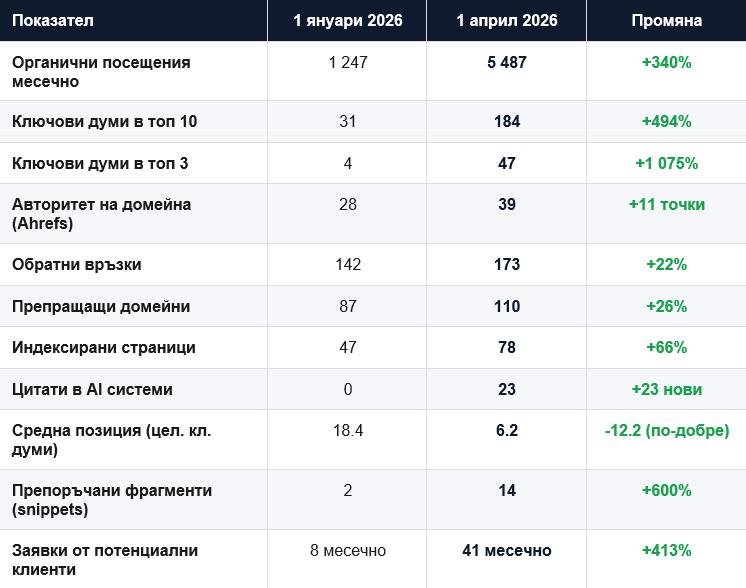
The most important business metric: organic leads. From 8 per month, they went up to 41. At a cost of EUR 67 per lead from paid advertising, this saves EUR 2,211 per month in paid acquisition costs (only for organic traffic leads). The project's payback period is less than 3 months.
- What DIDN'T work – the mistakes we made
This is the section that most case studies hide. We share it because mistakes are more useful than successes – they save you the time and money that we lost.
Mistake 1: AI content without expert refinement (days 8-15)
In the first 2 weeks we tried a pure AI process – Claude created articles, we published them directly. Result: zero rankings. Google recognized the signs of AI-generated text and demoted the articles. Lost: 2 weeks + 4 articles that we had to completely rework. Lesson: AI is always a first draft, never a finished product.
Mistake 2: Over-focusing on backlinks with DR 70+
In the first 4 weeks we wasted 18 hours trying to get links from top sites (Capital, Dnevnik, Investor). We got 1 backlink. When we refocused on thematically related sites with DR 40-60, in 2 weeks we got 12 backlinks. Lesson: quality does not equal DR. A thematically relevant site beats a high DR without relevance.
Mistake 3: Ignoring CTR optimization
For the first 6 weeks, we focused only on rankings, not CTR (click-through rate). When we analyzed Search Console, we saw that we had keywords in position 3-5 with CTRs below 2% (industry standard: 8-12%). The titles and meta descriptions were impersonal. We rewrote 38 titles and descriptions – CTR went up by an average of 4.7 percentage points in 14 days.
Mistake 4: We didn't follow AI quotes from day one
For the first 30 days, we didn’t have a system for tracking citations in AI systems. When we started (day 31), we didn’t know where we were. Lesson learned: set up AI citation tracking BEFORE you start any work, otherwise you’re working blindly.
Mistake 5: Abandoning the 15 low-quality old articles
We decided to „ignore“ them. Mistake. Google indexed them intermittently, and their poor quality was detracting from the overall quality of the site. On day 45, we removed them from public access and redirected them to related pages. The indexing budget was focused on high-quality content; rankings went up over the next 14 days. Lesson learned: outdated content is actively harmful, not just „neutral.“.
- What worked unexpectedly well?
The flip side of mistakes: techniques from which we had only modest expectations, but which yielded significantly more.
Victory 1: GEO techniques → 23 new AI quotes
We expected maybe 5-10 citations in AI systems in the first 90 days. Actual: 23. Definitions at the beginning of articles and FAQ sections work significantly better than expected. ChatGPT in particular quotes our FAQ answers almost verbatim.
Victory 2: Restructure internal links → +47% organic traffic
When we restructured internal linking (from random to systematic between anchor and related pages), organic traffic to the main pages jumped by 47% in 21 days – without any new content. Underrated optimization.
Win 3: Topic grouping beats SEO of individual articles
The supporting articles ranked for words we never explicitly targeted. Why? Related pages signal semantic authority on the topic. Google recognizes that the site is an expert in a given field, not just in specific keywords. Result: 73 of the 184 keywords in the top 10 were „random“ – that is, we didn’t explicitly target them.
Victory 4: Updating old articles → 31% of total growth
The 8 updated articles accounted for 31% of the total traffic increase, even though they only represented 22% of the total content. Updating existing content is more effective than writing new content. That’s why Step 2 (the review) proved critical.
Win 5: Visits from AI systems convert into customers 3.4 times better
From the 23 AI quotes, we noticed that visitors from ChatGPT and Perplexity converted to customers 3.4 times better than regular organic traffic. This is consistent with Position Digital data (15.9% for ChatGPT, 10.5% for Perplexity vs. 4-6% for Google organic).
- Can you repeat these results? Realistic expectations
Before you ask the question „when should I contact you for AI SEO“ – let’s be realistic about which factors make these results achievable and which ones DON’T.
Factors that allowed +340% in 90 days:
(1) The starting position was low (1,247 visits = large room for improvement); (2) The client has a high-quality product – the content had real value for the target audience; (3) The niche is competitive, but not oversaturated; (4) There was a budget for building authority (2 paid posts + expert editing); (5) The client's team responded quickly to questions about the content; (6) Domain age 18 months – neither too new nor too established.
When such results are UNREALISTIC:
(1) Sites with over 100,000 monthly visits – +340% is mathematically impossible in 90 days without a huge budget; (2) Highly competitive niches (insurance, finance, gambling) – the term should be 6-12 months; (3) New domains (under 6 months) – Google’s „sandbox“ effect; (4) Sites with a history of penalties – you need to work on recovery first; (5) Industries with low search volume – you can reach 100% from the market quickly, but the absolute numbers will be small.
Realistic expectations for 90 days of working with AI SEO:
For most Bulgarian B2B sites with proper execution: +50% to +200% increase in organic traffic. Above 200% – possible, but requires a combination of low starting position + correct niche + serious execution. Below 50% – a sign that something in the approach is wrong or the deadline is too short.
- Frequently asked questions about this case
Realistic answers to the most common questions about the AI SEO case, optimized for People Also Ask and Google AI Overviews.
No. AI SEO works best for: (1) B2B SaaS with medium to high deal size; (2) Ecommerce with medium brand authority; (3) Services with a lead value of over 200 EUR; (4) Media companies with high page volume. It works poorly for: services in small towns (this is where Local SEO works), industries with very low search volume, and sites with a history of penalties.
Classic SEO focuses on Google rankings and organic traffic. AI SEO adds optimization for: (1) citations in AI Overviews; (2) citations in ChatGPT and Perplexity; (3) featured snippets and People Also Ask sections; (4) voice search; (5) AI content creation and expert refinement. The two disciplines complement each other – AI SEO is the modern evolution, not a replacement.
First measurable results: 30-45 days (new pages start ranking). Steady growth: 60-90 days. Significant impact: 90-180 days depending on competition in the niche. Citations in AI Overviews can appear as early as the first 7-14 days after publication, but a sustainable presence takes 60-90 days.
Predictions for the end of 2026 - beginning of 2027: (1) AI Overviews will cover 60-70% of all searches (from 48% today); (2) ChatGPT search will reach 30% of global search traffic (today 20%); (3) Voice search will double the importance of conversational queries; (4) Visual search will become a ranking factor; (5) BgGPT and local AI systems will receive a specific focus on the Bulgarian market.
Conclusion: +340% is not magic, but a methodology
+340% in 90 days is not magic. It is the result of systematic implementation of a proven methodology: technical SEO foundation + thematic grouping of content + AI SEO + GEO optimization + authority building, implemented in parallel. The mistakes we made save you 2 weeks and 1,200 EUR – if you avoid them.
What surprised us the most weren’t the headline numbers (+340% organic traffic, +494% top 10 keywords). It was the side effects: visits from AI systems convert to customers 3.4x better, internal link restructuring yields +47% growth without new content, updating old articles generates 31% of the total growth. These findings are more valuable than the summary of the case.
The AI SEO landscape in 2026 is changing weekly. Competition is growing. AI Overviews appear in 48% of searches. The window for relatively easy wins is closing. Businesses that start systematic AI SEO now will have a significant advantage over those that wait 6-12 months. After that, wins will be significantly more expensive.