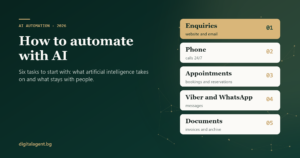

AI automation is the use of artificial intelligence to carry out business tasks on its own — tasks that used to require human intervention. Unlike conventional automation, which blindly follows preset rules, AI automation understands context, makes decisions and handles non-standard situations — it answers customers, processes documents and manages communication without a person having to oversee every step.
Imagine an employee who never sleeps, never makes mistakes due to fatigue, never goes on holiday and handles hundreds of tasks at once — at a cost that is a fraction of a single salary. This is not fantasy. It is the reality that AI automation brings to businesses today. And while large companies are already using it, for small and medium-sized businesses it is only now turning from a luxury into an accessible tool for gaining a competitive advantage.
In this guide, we will explain exactly what AI automation is, how it differs from what you already know, which processes you can automate and how to get started — without unnecessary technical jargon and with real examples from Bulgarian businesses. You will see specific applications by industry, the real benefits in figures and the steps for implementation.
Whether you run a hotel, an online shop, a restaurant or a B2B company, you will discover where AI automation can make a difference for you in particular.
What is AI automation: a definition
AI automation (or artificial intelligence automation) combines two things: automation — carrying out tasks without manual labour — and artificial intelligence, which adds the ability to understand, evaluate and adapt.
Classic automation has been around for decades. It is everywhere: an automatic email when a form is filled in, an invoice that generates itself, a reminder sent at a set time. But this kind of automation has one serious limitation — it only works when everything goes exactly to plan. Give it something unexpected and it fails.
AI automation removes this limitation. Thanks to artificial intelligence, the system no longer simply follows a script — it understands. It can read an email written in natural language, grasp what the customer wants and reply meaningfully. It can look at a document it has never seen before and extract the information it needs. It can make a decision in a situation it was not explicitly programmed for. This is precisely what turns automation from a rigid tool into a flexible digital employee.
AI automation vs conventional automation: the key difference
To understand the true value of AI automation, you need to see how it differs from the traditional approach. Here is a clear illustration.
Conventional automation works on the principle “if X, then Y”. It is like a train on rails — fast and reliable, but only along the track laid down in advance. Example: if a customer fills in a form, send them a standard email. Whatever the customer writes, the reply is always the same.
AI automation works on the principle “understand the situation and respond appropriately”. It is like an experienced employee — it can find its bearings in unfamiliar surroundings. Example: a customer writes an enquiry in their own words, and the AI system understands the specific question, checks the necessary information and replies in a personalised way — exactly as a human would.
In practice, the difference is huge. Traditional automation handles perhaps 60-70% of typical cases but fails with anything outside the template. AI automation also covers non-standard situations, which in real business are the rule rather than the exception. That is why it does not just speed up processes — it makes it possible to automate work that previously could not be automated at all.
How AI automation works
Behind every AI automation are several components that work together. You do not need to be an engineer to understand the logic.
1. Input (trigger)
Everything starts with an event — an incoming email, a phone call, a completed form, a new chat message, an uploaded document. This is the signal that triggers the automation.
2. Artificial intelligence (the brain)
This is where the magic happens. The AI model processes the input — it understands the text, recognises the intent and analyses the content. This is the component that sets AI automation apart from the conventional kind: the ability to understand rather than simply react mechanically.
3. Action
Based on that understanding, the system carries out a task — it sends a reply, creates a database record, generates a document, makes a booking or notifies an employee. Often a single event triggers a whole chain of actions across different systems.
4. Integrations
To do real work, AI automation connects to the tools you already use — email, a CRM system, a calendar, warehouse software, a messaging platform. This connectivity allows the automation to operate across your entire digital ecosystem rather than in isolation.
To build these automations, specialists use platforms that make it possible to design complex workflows visually and to connect dozens of different systems. The result is automation that runs quietly in the background and does the work of a whole team — without needing your attention until a genuinely complex case requires a person.
What AI can automate: specific processes
The theory is clear, but which real business processes can you automate with artificial intelligence? Here are the most common and most profitable applications.
- Customer service. AI chatbots and voice assistants answer questions around the clock, resolve typical issues and pass complex cases on to a human. Customers get an instant response at any time.
- Handling enquiries and emails. The system reads incoming messages, understands what they are about, categorises them and either replies automatically or routes them to the right department.
- Bookings and appointments. An AI agent handles calls and messages, checks availability and makes bookings — especially valuable for hotels, restaurants and service businesses.
- Data entry and processing. Extracting information from documents, invoices and emails and entering it into your systems automatically — no more manual copying.
- Content generation. Creating product copy, emails, social media posts and replies based on set guidelines.
- Sales support. Qualifying leads, following up on enquiries, sending personalised quotes and reminders.
- Document analysis. Reviewing contracts, reports and forms and extracting key information in seconds.
- Internal processes. Automating reports, notifications, coordination between teams and routine administrative tasks.
All of these processes have one thing in common: they are repetitive, time-consuming and follow a recognisable pattern. These are the ideal candidates for AI automation.
Real examples of AI automation by industry
Let's make things more concrete with examples from different sectors.
Hospitality. A voice AI agent answers the hotel phone around the clock, talks to guests in natural Bulgarian, checks room availability and takes bookings — even at 3 a.m., when reception is closed. The result: not a single missed call and staff with a lighter workload.
E-commerce. AI automation handles customer enquiries about orders and deliveries, updates stock levels, generates product descriptions and follows up on abandoned baskets with personalised messages.
Services and B2B. Incoming enquiries are qualified automatically, meetings are scheduled, quotes are sent out and communication with clients is maintained — without the manager losing hours to routine tasks.
Restaurants. Automated handling of bookings and orders by phone, chat and social media, with confirmations and reminders sent out automatically.
Manufacturing and logistics. Document processing, shipment tracking, automatic notifications when specific events occur and coordination of information between systems.
The benefits of AI automation for business
Why are so many companies investing in AI automation? Because the benefits are concrete and measurable — not abstract promises, but real results that are reflected in the bottom line. Here are the most important ones.
Time saved. Tasks that take hours of human effort are completed in seconds. Your team is freed up for the work that genuinely requires a person — strategy, creativity and personal relationships with customers.
Reduced costs. A single AI automation does the work of several employees on routine tasks, at a cost that is a fraction of one salary. The return on investment usually comes quickly.
Working around the clock. AI does not sleep, does not rest and does not go on holiday. Your business runs 24 hours a day, 7 days a week — serving customers and processing tasks even while you sleep.
No mistakes due to fatigue. People make mistakes, especially with monotonous tasks. AI automation performs every task with the same precision, whether it is the first of the day or the thousandth.
Scalability. As your business grows, AI automation grows with it, without the need to hire people in proportion. Ten enquiries or a thousand — the system copes equally well.
Satisfied customers. Instant replies, round-the-clock availability and no waiting mean a better customer experience — and, in turn, greater loyalty.
What a real AI automation looks like: a step-by-step example
To make this completely tangible, let's follow one specific automation from start to finish — handling a customer enquiry in an online shop.
At 23:40 a customer sends a message: “Hello, I ordered trainers 3 days ago, when will they arrive?” Reception is closed and the team is asleep. But the AI automation is at work.
First, the system receives the message (the trigger). The AI reads it and understands two things — the customer is asking about delivery status and mentions a specific product. The system then automatically checks the warehouse software to find this customer's order and its delivery status. It finds the information: the parcel has been dispatched and will arrive tomorrow.
Finally, the AI generates a personalised reply: “Hello! Your order of trainers has been dispatched, and we expect it to arrive tomorrow by the end of the day. You will receive an SMS from the courier on delivery. Have a lovely evening!” The customer gets an instant, accurate reply at 23:40 — without a single person being involved.
This is the power of AI automation in practice. A task that would otherwise have waited until morning and taken up an employee's time is resolved instantly, at any hour and without error. Multiply that by hundreds of enquiries a month and you can see why the impact on the business is so great.
Where a company should start with AI automation
The biggest mistake when starting out is the ambition to automate everything at once. This almost always leads to confusion and disappointment. The right approach is different — step by step.
Step 1: Find the most painful process. What takes up the most time for your team? What is repetitive and tedious? What slows down customer service? Start where automation will bring the most tangible benefit.
Step 2: Start with one process. Choose one specific task — for example, handling customer enquiries — and automate it. Do not spread your efforts too thin. One process that works well is worth more than ten half-finished ones.
Step 3: Measure the result. How much time have you saved? How much faster are you serving customers? How many fewer mistakes are you making? The numbers will show you the value and justify the next step.
Step 4: Expand. Once the first process is running reliably, add a second, then a third. Gradually you build an ecosystem of automations that work together — but each one has proven its worth.
This is the same approach we take with our clients. We start with a pilot process, prove the real benefit and expand from there. That way, the investment is protected and the results are visible from the very start.
Common myths and mistakes in AI automation
There are misconceptions about AI automation that stop businesses from making the right decisions. Let's clear them up.
Myth: AI automation costs tens of thousands. This is perhaps the most widespread myth. The reality is that many solutions for small and medium-sized businesses are considerably more affordable, and the return on investment comes quickly. The price depends on complexity, not on some fixed high figure.
Myth: I need to be tech-savvy. No. Building and maintenance are entrusted to specialists. Your role is to describe what you want to automate. The system itself is designed to be easy to use.
Myth: AI will replace my entire team. AI automation takes over the routine, not the people. It frees your team for work that requires human judgement, creativity and emotion — the areas in which people are irreplaceable.
Mistake: Automating everything at once. The ambition is commendable but risky. Start with one process, prove its value, then expand.
Mistake: Relying on a single AI model. Technology changes fast. Good automations are built flexibly, so they can swap the underlying model without the business coming to a standstill — something we learned well over the past year of rapid change in the industry.
Frequently Asked Questions
What is AI automation?
What is the difference between AI automation and conventional automation?
Which business processes can be automated with AI?
How much does AI automation cost for a small business?
Do I need to be tech-savvy to implement AI automation?
Conclusion: automation is not the future, but the present
AI automation is no longer a technology reserved for large corporations. It is an accessible tool that any business — large or small — can use to work faster, cheaper and better. The question is no longer whether to automate, but which processes and how soon.
The competition is not waiting. Every day of delay is a day in which a rival serves customers faster, works around the clock and cuts its costs with the help of artificial intelligence. The good news is that the barrier to entry has never been lower — and the first step is simpler than you think.
If you would like to see exactly which processes in your business are worth automating and what that would look like in practice, the Digital Agent team is here to help. We start with a conversation in which we get to understand your needs, and we propose a solution that delivers real value from day one.
To learn more, see also what is meant by AI agents for business, how much an AI agent actually costs in Bulgaria, and if you are new to the topic — what is artificial intelligence.
Contact us for a free consultation →
Digital Agent (AI AVTOMATIZATSII OOD) is a specialist agency for AI automation, AI agents and integrations. We build practical, durable solutions for hotels, restaurants, online shops and B2B companies in Bulgaria, Greece and Romania.