
Updated: November 2026
Artificial intelligence (AI; in Bulgarian ИИ) is technology that lets computer systems carry out tasks that normally require human reasoning: they understand language, recognise images, make decisions and learn from examples. Unlike ordinary software, which follows rules written in advance, artificial intelligence finds patterns in data and improves with them. Every system we use today – from the spam filter to ChatGPT, Gemini and Claude – is so-called narrow artificial intelligence: strong at specific tasks, but without consciousness or a will of its own.
Sounds complicated? It isn't. In fact, you already use artificial intelligence dozens of times a day — when Google finishes your sentence, when Netflix suggests your next film, when your phone recognises your face. AI is not technology from a science-fiction film. It is here, all around us, quietly changing the way we live and work.
In this guide, we will explain simply and clearly exactly what artificial intelligence is, how it works, what types exist and where you already come across it — without unnecessary technical jargon. We will look at its history, real examples from everyday life, applications by industry and the most widespread myths. And at the end, you will see why this is no longer just an interesting topic for tech enthusiasts, but something every business needs to understand.
Whether you are a complete beginner or simply want to organise what you have already learnt, this article will give you a clear and complete picture. Let's start with the basics.
What artificial intelligence means: a definition
The term “artificial intelligence” (AI for short) describes computer systems capable of performing tasks that normally require human reasoning.
The key difference from traditional programs lies in the approach. Conventional software works on the principle of “if X happens, do Y” — the programmer describes every rule in advance. Artificial intelligence works differently: instead of telling it exactly what to do in every situation, we show it thousands of examples and let it discover the patterns by itself.
Imagine you are teaching a child to recognise a cat. You don't give them a list of rules (“it has whiskers, four legs, a tail”). You simply show them lots of cats until they learn on their own. Artificial intelligence is trained in the same way — through examples, not rules. It is precisely this ability to learn that makes AI so powerful and so different from everything that came before it.
Types of artificial intelligence
The types of artificial intelligence are most often divided by three criteria: by capability (narrow, general and superintelligence), by how they work (reactive systems, limited-memory systems, “theory of mind” and self-aware AI) and by purpose (generative, predictive and AI agents). Everything that exists today is narrow artificial intelligence. General artificial intelligence, superintelligence, “theory of mind” and self-aware AI are only theoretical.
Types by capability
Narrow artificial intelligence (Narrow AI, ANI). The only type that exists today. It specialises in a defined set of tasks – face recognition, translation, playing chess, working with text. ChatGPT, Gemini and Claude are narrow AI too: very good with language, but they cannot drive a car on their own and have no emotions.
General artificial intelligence (General AI, AGI). A system that would learn and apply knowledge in any field the way a person does. No such system exists yet. When, and whether, it will appear is a matter of debate.
Superintelligence (ASI). A hypothetical AI that surpasses humans at everything. For now it is only a theoretical concept.
Types by how they work
Reactive systems. They respond only to the current situation and do not remember earlier ones. An example is the chess computer Deep Blue.
Limited-memory systems. They learn from past data and use it in their next decision. Almost all of today’s systems belong here – chat assistants, film and music recommendations, cars with autonomous driving.
“Theory of mind”. A hypothetical type that would understand people’s emotions and intentions. It does not exist.
Self-aware artificial intelligence. A hypothetical type with a consciousness of its own. It does not exist.
Types by purpose
Generative artificial intelligence. It creates new content – text, images, sound, video, code. Examples are ChatGPT, Gemini and Claude.
Predictive (analytical) artificial intelligence. It does not create content; it recognises and forecasts: spam filters, fraud detection, demand forecasts.
AI agents. Systems that do not just answer but carry out a task step by step – they check information, book an appointment, hand the conversation over to a person. More in our guide What is an AI agent.
| Type | Exists today? | Example |
|---|---|---|
| Narrow AI | Yes | translator, spam filter, chat assistant |
| General AI (AGI) | No | – |
| Super Intelligence (ASI) | No | – |
| Generative AI | Yes | ChatGPT, Gemini, Claude |
| Predictive AI | Yes | fraud detection, forecasts |
| AI agents | Yes | chat and voice agents for customer service |
A brief history of artificial intelligence
Artificial intelligence is not a new idea — it has a history of nearly 70 years.
It all began in 1950, when the British mathematician Alan Turing asked the famous question “Can machines think?” and proposed the Turing test — a way of judging whether a machine can imitate human conversation convincingly enough.
In the summer of 1956 at a historic conference at Dartmouth, the term “artificial intelligence” itself was coined by the scientist John McCarthy. This was the official birth of AI as a scientific discipline.
Decades of ups and downs followed. In 1997 IBM's Deep Blue computer defeated the world chess champion Garry Kasparov — a moment that shocked the world and showed that machines could outdo humans in complex strategic tasks. In 2011 IBM Watson won the TV quiz show Jeopardy!, demonstrating an understanding of natural language.
The real revolution, however, came only very recently. In 2017 researchers at Google published the paper “Attention Is All You Need”, which introduced the so-called transformer architecture — the foundation of modern AI. And in November 2022 OpenAI launched ChatGPT, and within a matter of days millions of people were “talking” to artificial intelligence for the first time.
After ChatGPT, other mass-market assistants followed – Google’s Gemini, Anthropic’s Claude, Microsoft’s Copilot and, in Bulgaria, BgGPT from the INSAIT institute. In 2024 the European Union adopted Regulation (EU) 2024/1689 on artificial intelligence, whose requirements apply in stages. We compare which chat suits you in our guide artificial intelligence in Bulgarian.
How artificial intelligence works
To understand how artificial intelligence works, you need to know three key concepts: data, algorithms and training.
1. Data is the fuel
Artificial intelligence needs huge amounts of data in order to learn. This can be text, photos, sounds, numbers — anything at all. The more data the system receives, and the better its quality, the better it performs. Just as a person who has read thousands of books understands language better than someone who has read only a few.
2. Algorithms are the recipe
An algorithm is a set of mathematical instructions that tell the system how to process data and find patterns. Different tasks require different algorithms — one for image recognition, another for language understanding, a third for forecasting.
3. Training is the process
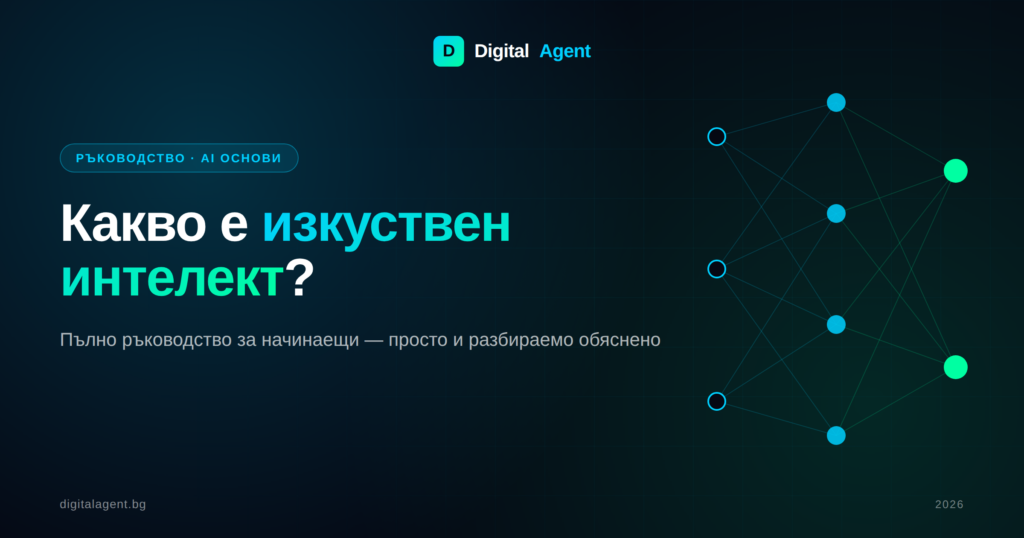
During training, the system “absorbs” the data and gradually adjusts its internal parameters until it starts producing accurate results. This process often uses so-called neural networks — computational structures loosely inspired by the way the human brain works. A neural network consists of layers of interconnected “neurons” that together learn to recognise increasingly complex patterns.
When you hear terms such as “machine learning” or “deep learning”, they refer to different approaches to this very learning process. Let's clear them up.
An example of how it works in practice
To make it completely clear, let's follow a concrete example — how AI learns to recognise whether there is a dog in a photo.
First, the system receives thousands of photos, each labelled “dog” or “not a dog”. This is the training data. The neural network then starts processing the photos and gradually discovers patterns — shapes, textures and outlines that are typically present in dogs. At first, it often gets things wrong. But with each photo, it adjusts its internal parameters and improves.
After enough training, something remarkable happens: the system can recognise a dog even in a photo it has never seen before. It does not remember the specific photos — it has learnt the very concept of “dog”. It is precisely this ability to generalise that sets artificial intelligence apart from an ordinary program and makes it so flexible.
Machine learning and deep learning: what's the difference
These two terms are often confused with “artificial intelligence”, but each means something specific. The easiest way is to picture them as Russian nesting dolls — one inside the other.
Artificial intelligence is the broadest concept — any technique that makes machines imitate human intelligence.
Machine learning (ML) is a subfield of AI. It is the method by which a system learns from data without being explicitly programmed for each individual case. When your email service learns to recognise spam by observing which messages you flag — that is machine learning.
Deep learning (DL) is an even narrower subfield of machine learning. It uses multi-layered neural networks (hence “deep”) and is behind the most impressive achievements of modern AI — speech recognition, image generation, language models such as ChatGPT.
In short: all deep learning is machine learning, and all machine learning is artificial intelligence — but not the other way round.
Real examples of artificial intelligence in everyday life
Artificial intelligence is already deeply embedded in your daily life — often without you even realising it. Here is where you encounter it every day:
- Voice assistants. Siri, Google Assistant and Alexa understand your speech and answer questions thanks to natural language processing AI.
- Content recommendations. When Netflix suggests the next film, YouTube the next video and Spotify a new song, behind it all is artificial intelligence analysing your taste.
- Social media. What you see on Facebook and Instagram is arranged by AI algorithms based on your interests.
- GPS navigation. Google Maps calculates the fastest route, predicts traffic and recalculates in real time with the help of AI.
- Spam filters. Your email automatically filters out unwanted messages — that is machine learning in action.
- Facial recognition. Unlocking your phone with your face uses artificial intelligence.
- Online shopping. The “people also buy” recommendations and dynamic pricing are driven by AI.
- Chatbots. More and more websites offer intelligent assistants that answer questions around the clock.
You will find more cases from business and by industry in our article 25 examples of artificial intelligence.
Artificial intelligence by industry
Beyond everyday life, artificial intelligence is transforming entire sectors of the economy.
Healthcare. AI helps diagnose diseases faster and more accurately, analyse medical images and speed up the discovery of new medicines.
Finance. Banks and insurers use artificial intelligence for fraud detection, creditworthiness assessment and automated risk analysis.
Manufacturing. Robotic systems and predictive maintenance powered by AI increase efficiency and reduce breakdowns.
Retail. Online shops personalise offers, forecast demand and optimise stock levels using artificial intelligence.
Customer service. Chatbots and voice assistants handle routine enquiries around the clock, freeing up teams for more complex cases.
Hospitality. Voice AI agents already answer the phone at hotels, talk to guests in natural language and take bookings at any hour of the day or night — a direct response to the staff shortage in tourism.
Common myths about artificial intelligence
Many misconceptions have built up around AI. Let's debunk the most common ones.
Myth: Artificial intelligence thinks like a human. No. Today's AI recognises patterns in data — it has no consciousness, understanding or intentions. When ChatGPT “answers”, it does not understand the meaning the way a human does; it predicts which words are most likely to come next based on its training.
Myth: AI will soon take over the world. The scenarios in films are far from reality. Modern artificial intelligence is narrow — specialised in specific tasks and lacking any will of its own. The real risks are more down to earth: disinformation, bias, misuse.
Myth: AI will put everyone out of work. Artificial intelligence automates tasks, not entire professions. History shows that every technological revolution destroys some jobs but creates others — often more than it eliminates.
Myth: AI is only for big tech companies. Quite the opposite. Today, artificial intelligence tools are accessible to businesses of any size — including small companies in Bulgaria. The barrier to entry has never been lower.
Why artificial intelligence is booming right now
Artificial intelligence has existed for 70 years, but only in the last few has it experienced a real explosion. Why now? Three factors came together at the ideal moment.
First — data. We live in an age in which humanity generates unimaginable amounts of digital information every day. This data is the fuel without which AI cannot learn. For the first time in history, it is abundant.
Second — computing power. Training modern AI models requires colossal processing power. Thanks to advances in specialised chips and cloud technologies, this power is now accessible and financially viable.
Third — breakthroughs in algorithms. The transformer architecture of 2017 unlocked a qualitative leap in AI's ability to understand language and context. What was previously impossible suddenly became reality.
When these three factors came together, the shift from “an interesting technology for researchers” to “a tool anyone can use” took place. After ChatGPT appeared at the end of 2022, a conversation with artificial intelligence became available to anyone with a phone or a computer. This was no coincidence, but the result of decades of build-up that finally bore fruit.
For business, this means something concrete: the barrier to entry has collapsed. Technology that until a few years ago required a team of scientists and millions in investment is now accessible to a company of any size. That is exactly what makes this moment so important — and such a bad time to wait.
Artificial intelligence for business: why it matters now
So far, we have looked at what artificial intelligence is in theory. But the real question for every business owner is: what does this mean for me?
The answer is simple — AI is no longer a luxury or an experiment. It is a competitive advantage that your rivals are either already using or will soon be using. Artificial intelligence can take over customer service around the clock, automate repetitive tasks, process enquiries, analyse data and free up your team for the work that genuinely requires a human.
The most accessible starting point for most companies is AI agents — intelligent systems that carry out specific business tasks on their own. If you are wondering what this looks like in practice, have a look at our guide on what AI agents for business are and the real-world examples of how they are applied.
A common concern is the price. The myth that an AI solution costs tens of thousands of leva stops many companies before they even start. The reality is different — we debunk this myth in detail in the article on how much an AI agent really costs in Bulgaria.
And to find out where the technology is heading and how to prepare your business for the years ahead, see our analysis of the future of artificial intelligence.
What we can build for you
If you are reading about artificial intelligence because you are thinking about how to use it in your company: at Digital Agent we build AI agents that do specific work.
- AI chat agent for your websitethat answers customers from your prices and documents and records enquiries;
- AI voice agentthat answers the phone, responds to questions and books an appointment or reservation;
- Agent on Viber and WhatsApp, where your customers already write;
- Automation of repetitive tasks – enquiries, documents, reports.
You start with one process – the one that takes up most of your time. You will find ideas in our guides artificial intelligence for business: 15 applications and implementing artificial intelligence in 7 steps. book a free consultation and we will show you how this would look for your business.
Frequently Asked Questions
What is artificial intelligence in simple terms?
Artificial intelligence (AI) is a technology that enables computers to perform tasks that require human intelligence — understanding language, recognising images, making decisions and learning from experience. In short: software that learns and solves problems instead of simply following strictly defined instructions.
What are the types of artificial intelligence?
By capability there are three types: narrow, general and superintelligence, and only narrow AI exists today. By purpose, there is generative AI, which creates content, predictive AI, which recognises and forecasts, and AI agents, which carry out tasks.
What is the difference between artificial intelligence and machine learning?
Artificial intelligence is the broad concept of machines that imitate human intelligence. Machine learning is a subfield of AI — a specific method in which a system learns from data without being explicitly programmed for every case. Put simply: all machine learning is artificial intelligence, but not all artificial intelligence is machine learning.
Is artificial intelligence dangerous?
Today's artificial intelligence is not dangerous in itself — it has no consciousness, will or intentions. The real risks come from the way people use it: disinformation through deepfakes, personal data breaches, voice-cloning scams and algorithmic bias. Managing these risks requires sensible use, regulation and education.
What are some examples of artificial intelligence in everyday life?
Artificial intelligence is all around us: voice assistants such as Siri and Alexa, recommendations on Facebook, YouTube and Netflix, GPS navigation, email spam filters, facial recognition on your phone, customer service chatbots and tools such as ChatGPT for writing and analysis.
Can artificial intelligence replace people?
Artificial intelligence automates specific tasks, but it does not completely replace entire professions. Routine and repetitive activities are the most affected, while roles that require creativity, empathy and complex judgement are more likely to be complemented by AI. The future lies in collaboration between human and machine, not in complete replacement.
Conclusion
Artificial intelligence is no longer a technology of the future — it is a reality of the present that is quietly changing the way we live and work. From the voice assistant on your phone to the systems that diagnose diseases and drive businesses, AI is all around us.
A good understanding of what artificial intelligence is — and what it is not — is the first step towards using it to your advantage instead of watching from the sidelines. The technology is neither magic nor a threat. It is a tool. And like any tool, its value depends entirely on who uses it and how.
If you are ready to take the next step and see how artificial intelligence can work specifically for your business, the Digital Agent team is here to help — from the initial idea to a working solution.
Contact us for a free consultation →
Digital Agent is a specialist agency for artificial intelligence, AI agents and automation. We build practical AI solutions for hotels, restaurants, online shops and B2B companies in Bulgaria, Greece and Romania.