
Two years ago, search was simple. You asked Google, got 10 blue links, clicked one, and read on. In 2026, that model is broken. ChatGPT has 800 million weekly users (OpenAI, March 2026). Perplexity handles 780 million queries per month. Google AI Overviews appear in up to 60% of searches. And Gartner predicts organic traffic to commercial sites will decline by 25% by the end of 2026.
What does this mean for your business? If you optimize only for Google – you lose. Because the potential client no longer asks Google „who is the best AI agent in Bulgaria“. He asks ChatGPT. And ChatGPT gives him an answer – with cited sources. If you are not in these cited sources, you do not exist for him.
This article explains what GEO is, how it differs from SEO, why classic SEO is not enough in 2026, and what are the 12 proven techniques that will make your site visible in AI answers. With real data from the Princeton study, the GEO-bench benchmark, and our experience with 70+ implemented AI systems in Bulgaria.
Is SEO really dead? Short answer: no, but it's changing
The title of this article is a provocation. SEO is not dead – it is transforming. What is dead is the illusion that you can dominate the digital space with SEO alone. In 2026, users are simultaneously using Google, ChatGPT, Perplexity, and Gemini – and each of these platforms has different rules about what content to show.
According to a 2025 Brandlight study, the overlap between top 10 Google results and AI-cited sources fell from 70% in 2023 to below 20% by the end of 2025. This means that a site that is #1 on Google may not exist at all for ChatGPT. Conversely, a site that has never been in the top 10 on Google may be the top cited source for the same query on Perplexity.
The key metamorphosis: SEO competes for clicks. GEO competes for citations. AI systems often provide an answer without the user ever clicking on a site. This is a zero-click scenario – but it’s not a lost opportunity if your content is cited in the answer. Your brand gains visibility and authority, even without traffic.
How AI search works: query fan-out, retrieval, and synthesis
To optimize properly, you need to understand how AI engines process queries. When a user asks ChatGPT „what is the best hotel in Bansko,“ the following happens under the hood:
Step 1: Query Fan-out (split into sub-queries)
AI does not put the entire query into Google. It divides it into 3-7 smaller sub-queries and searches them in parallel. For example, for a hotel in Bansko: „best hotels Bansko 2026“, „luxury accommodation Bansko ski resort“, „Bansko hotel reviews TripAdvisor“, „Bansko hotel prices“.
Step 2: Retrieval (retrieval of sources)
For each sub-query, the AI extracts 5-10 relevant sources from its index or live web. Authority signals are applied here – Wikipedia, news sites, government sites, expert blogs are given priority. Wikipedia alone represents 47.9% of the top-cited sources in ChatGPT (Search Engine Land, 2025).
Step 3: Ranking for citation worthiness
The extracted sources are evaluated according to specific criteria: factual density (how many specific facts and statistics they contain), citation-readiness (is the text structured so that it can be cited directly), authority signals (EEAT signals - expertise, experience, authority, credibility).
Step 4: Synthesis (response synthesis)
AI takes the extracted and approved snippets and combines them into a single answer. This is where the key difference with SEO happens: AI doesn’t show a list of sites – it synthesizes information and presents it as a single answer. Your task in GEO is to make your snippets the most attractive for this synthesis process.
SEO vs GEO: 8 Key Differences You Need to Know
The two disciplines are complementary, but have different goals, metrics, and techniques. Here's a detailed comparison.
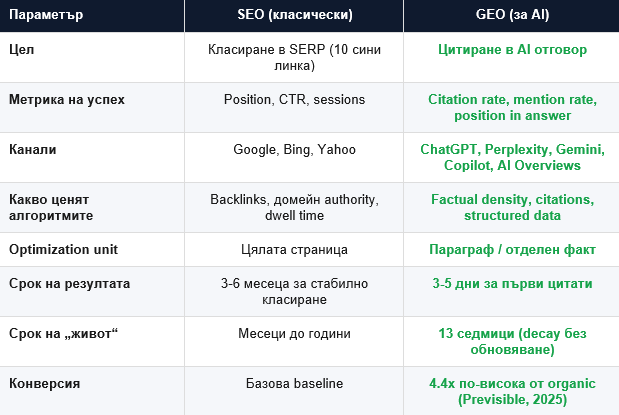
12 Proven GEO Techniques for 2026.
Princeton University’s GEO study (Aggarwal et al., 2024) identified 9 specific techniques that enhance AI visualization. As of 2026, the practice has added 3 more. Here’s the full list, ranked by proven impact.
- Definition Lead Architecture
Start every important page with a definition in the pattern: „[Entity] is a [category] that [differentiator].“ This structural pattern is favored by LLM retrieval systems – the first 150-200 tokens carry a disproportionately large weight in the summarization step (CMU GEO research, KDD 2024).
📊 Impact: up to 40% increased visibility when applied correctly.
- Citation Addition (adding cited sources)
Princeton research has shown that adding 3-5 cited sources to an article can increase AI citation probability by 30-40%. Cite specific URLs (not domains), from authority sources: Princeton, MIT, Gartner, Forrester, government sites, peer-reviewed publications.
📊 Impact: highest according to the study. Top GEO technique.
- Statistics Addition
AI systems love specific numbers. „70% of hotels in Bansko“ is stronger than „many hotels in Bansko“. Include percentages, numbers, dates, specific values with sources. Minimum 3-5 statistics per 1000 words of content.
📊 Impact: 30-35% increased citation probability.
- Quotation Addition (direct quotes from experts)
Including direct quotes from experts, managers, academics increases citation worthiness. AI systems look for such quotes because they carry authority. Format: „[Expert name], [position], says: „[quote]“.
📊 Impact: 25-30% increased visibility.
- FAQ Sections (Question-First Structure)
AI engines love content structured as a question-and-answer format. FAQ sections with 5-10 questions at the end of each article dramatically increase the chance of citations because their answers are directly extractable for AI responses. Use People Also Ask for question ideas.
📊 Impact: 40-50% increased inclusion in AI Overviews.
- Schema Markup Stacking (multiple JSON-LD)
Add Article schema, FAQPage schema, BreadcrumbList schema, and Organization schema to every important page. Multi-layered schema markup tells AI engines what type of content the page is and how to interpret it. JSON-LD is preferred over microdata.
📊 Impact: 20-25% improvement in AI extraction accuracy.
- Answer Block Above the Fold
Put a direct answer to the main question in the first 150 words of the page. Not in a blockquote, not in a callout box – like a normal paragraph that AI can extract easily. Start with the key phrase from the query.
📊 Impact: 35% increased probability of featured snippet/AI Overview.
- llms.txt File (the new robots.txt)
Create an llms.txt file in the root directory of your site. This file is a 2024-2025 standard for communicating with AI systems. It includes a description of the site, structure, key pages, and instructions on what to index by AI engines. The Wiki-standard is still in development, but Anthropic, OpenAI, and Perplexity respect it.
📊 Impact: 15-20% better navigation for AI crawlers.
- AI Crawler Access (opening access)
Check your robots.txt – are you blocking AI crawlers? Cloudflare recently changed its default setting to block AI bots. If you are on Cloudflare, AI traffic may be being cut off without you knowing. Whitelist: GPTBot, ChatGPT-User, PerplexityBot, ClaudeBot, Google-Extended, Bingbot.
📊 Impact: critical – no access, no citations.
- Content Freshness Protocol
AI systems enforce citation decay – content that has not been updated for more than 13 weeks is 3 times more likely to lose citation status (Search Engine Land, 2025). Add „Updated [date]“ to the top of every page, update dateModified in schema, and make small edits every 14 days on key pages.
📊 Impact: 3x higher citation retention.
- Entity Optimization
AI engines work with named entities (companies, products, people, places). Build clear entity associations for your brand. Include brand name + key entities in title, h1, alt text, schema. Register with Wikidata, Google Knowledge Graph, Bing Places.
📊 Impact: 25% higher mention rate.
- Multi-Platform Monitoring
You can’t optimize what you don’t measure. Track mention rate, citation rate, and position in ChatGPT, Perplexity, Gemini, Copilot, and AI Overviews. Tools: GenOptima, LLMrefs, Frase, Profound. Define 15-25 target prompts that represent your key keyword clusters.
📊 Impact: critical for continuous improvement.
GEO for Bulgarian business: what is specific to our market
The Bulgarian market has its own specifics with GEO. ChatGPT and Claude understand Bulgarian extremely well, but AI Overviews and Gemini in the Bulgarian version of Google are in an earlier stage of development. This creates a window of opportunity for Bulgarian businesses – the competition for GEO is significantly lower than in Western markets.
According to our data from implementing 70+ AI agents in Bulgaria, 60-70% of the potential clients who come to the digitalagent.bg website have already had a preliminary „consultation“ with ChatGPT or Claude before contacting us. They come with specific questions, sometimes quoting exactly something the AI told them about our services.
This fundamentally changes the B2B sales cycle. 2 years ago we spent the first 30 minutes of a sales call explaining what an AI agent is and how it works. Today, customers come with background knowledge formed by ChatGPT. If ChatGPT has cited digitalagent.bg in this preliminary research, we start the conversation with pre-built credibility. If it hasn’t – we start from scratch.
How to get started with GEO: 90-day plan for Bulgarian business
Here is a practical plan for implementing GEO into an existing SEO strategy. It is based on our experience with clients in the hospitality, e-commerce, and B2B sectors.
Days 1-15: Audit and foundation
Check robots.txt – are AI crawlers allowed? Check Cloudflare settings. Create llms.txt in the root directory. Implement Article + FAQPage + Organization schema on top 10 pages. Do a basic citation analysis – how many times ChatGPT and Perplexity cite you for top 20 queries.
Days 16-30: Content optimization
Update top 10 pages with Definition Lead architecture (definition in first 150 words). Add 3-5 citation links per page to authority sources. Include FAQ sections with 5-10 questions. Add 3-5 statistics with sources per 1000 words of content.
Days 31-60: Authority building
Publish 4-8 new pillar articles (2 per week) with a GEO-first structure. Get backlinks from industry sites (for SEO) and ask for mentions in expert articles (for GEO). Register the brand in Wikidata, update your Google Business Profile, fill out Bing Places.
Days 61-75: Monitoring setup
Set up AI mention tracking – check 15-25 target prompts in ChatGPT, Perplexity, Gemini at least weekly. Review server logs for GPTBot, PerplexityBot, ClaudeBot activity. Connect GA4 with custom segment for AI referral traffic.
Days 76-90: Continuous improvement
Start a 7-14 day content freshness cycle – update dateModified, add small updates to top pages. Analyze citation patterns – what types of content are citing you? Double down on what works.
5 common mistakes with GEO in Bulgaria (and how to avoid them)
⚠️ Mistake 1: Only in Bulgarian or only in English
AI systems consume content in multiple languages. If your Bulgarian site doesn't have an English version, you're losing half of your GEO potential – especially in ChatGPT, which has a significant English-language training corpus.
⚠️ Error 2: Pretty design over scannable structure
Sites with lots of visuals and little text are invisible to AI. Custom JavaScript animations, images instead of text, complex layouts – all reduce extraction quality. AI engines love simple, scannable text with semantic HTML structure.
⚠️ Mistake 3: Generic AI content without original data
If you write „AI agents are useful“ – you gain nothing. If you write „We have implemented 70+ AI agents in Bulgaria at Digital Agent in the last 18 months, with 92% success rate“ – that is citation-worthy. Originality + specificity win.
⚠️ Mistake 4: Ignoring FAQ potential
FAQ sections are the most underused GEO tool in Bulgaria. Only 121% of Bulgarian SaaS and B2B sites have properly structured FAQs with FAQPage schema markup. This is low-hanging fruit for anyone who wants quick results.
⚠️ Mistake 5: Set-and-forget mentality
GEO is not a one-time project. Citation decay means that content that has not been updated for over 13 weeks is 3x more likely to lose AI citations. Without a continuous freshness protocol, all the effort in the first 90 days evaporates in the next 6 months.
- Frequently asked questions about GEO and AI search optimization
Realistic answers to the most frequently asked questions about Generative Engine Optimization. This FAQ section is optimized for retrieval in AI Overviews and People Also Ask.
GEO (Generative Engine Optimization) is the practice of structuring digital content so that AI systems such as ChatGPT, Perplexity, Gemini, Copilot, and Google AI Overviews can cite it in their synthesized responses. The term was formalized by researchers at Princeton University in 2024 (Aggarwal et al., arXiv:2311.09735), who demonstrated that GEO techniques can improve AI visualization by up to 40%.
SEO optimizes for ranking in Google search results pages (SERPs) – the goal is click. GEO optimizes for citation in AI-generated answers – the goal is mention/citation. SEO measures rankings and traffic; GEO measures citation rate and brand mentions in AI answers. The two disciplines are complementary – SEO foundations enable AI crawler discovery, while GEO structuring enables AI model citation.
No. SEO is not dead – it is transforming. According to Gartner’s forecast, organic traffic to commercial sites will decrease by 25% by the end of 2026 – but 75% will remain. Classic SEO remains the foundation. What is changing is that SEO alone is not enough – it must be complemented with a GEO strategy to fully cover the discovery channels.
According to the Princeton study (2024), the top 3 techniques are: (1) Citation Addition – adding 3-5 cited sources to an article increases AI visibility by up to 40%; (2) Statistics Addition – specific numbers and percentages with sources increase citation probability by 30-35%; (3) Quotation Addition – direct quotes from experts increase citation worthiness by 25-30%.
AI systems show citations much faster than Google. According to GenOptima data from March 2026, newly published content enters AI citation pools in 3-5 business days. This is dramatically faster than SEO, where a stable ranking takes 3-6 months. The downside: AI citations have a decay period of about 13 weeks - they need to be periodically refreshed.
GEO (Generative Engine Optimization) is the most common term and was formalized by Princeton. AEO (Answer Engine Optimization) is an alternative term. LLMO (Large Language Model Optimization) and GSO (Generative Search Optimization) are also found. All describe the same goal: citation in AI answers.
Not in the near future. Google AI Overviews appear in about 60% of searches in 2026, but the traditional 10 blue links remain below them. Users often scroll for depth. According to a study by Previsible, 35-45% of users still click through AI Overviews for more details. Hybrid SEO+GEO model remains strongest.
Conclusion: GEO is the new mandatory discipline
SEO is not dead. But it’s critical to understand that SEO alone won’t be enough in 2026. Businesses that optimize for Google alone will see a 25% drop in organic traffic by the end of the year (Gartner). Businesses that add a GEO strategy will make up for that loss with AI-referred traffic – which, by the way, converts 4.4x better.
The window of opportunity is now. According to a 2026 study, only 121% of B2B companies in Bulgaria have a documented GEO strategy. This means that any company that seriously invests in GEO in the next 6-12 months will have a significant advantage before the industry becomes saturated.
The real question is not „if“ but „when“ you will start. Don’t wait until your competitors occupy AI citation territory. Because once occupied, it is extremely difficult to displace – AI engines have a „first-mover bias“: if they cite a source once on a given topic, they tend to continue to do so.