As of late October 2026, the Artificial Analysis index is led by Anthropic's Claude Opus 5.5 (58 points), followed by Claude Sonnet 5.5 and Meta's Muse Wonder Full (56 each), then Moonshot's Kimi K3.1 Pro (55). The flagships OpenAI's GPT-6 Astra, Claude Fable 5.1 and Google's Gemini 4 Argon score 53 points each. The best open-weight models, the ones you can run on your own server, come mainly from Chinese labs: the leader among them, Xiaomi's MiMo-V2.6-Pro, scores 46 points in the same index. For 2027, the more useful question is which model for which task, at what price, and where the data goes.
The data in this article was checked as of 27 October 2026.
The AI model landscape as of October 2026
A language model (LLM) is the program that understands and writes text; the basics are covered in our guide what is artificial intelligence. An AI agent uses a language model but also acts: it checks availability, makes a booking, sends a confirmation. We explain the difference between an AI agent, an assistant and a chatbot separately. Most companies use a model through an API: the connection through which your system sends text to the provider's model and receives a reply.
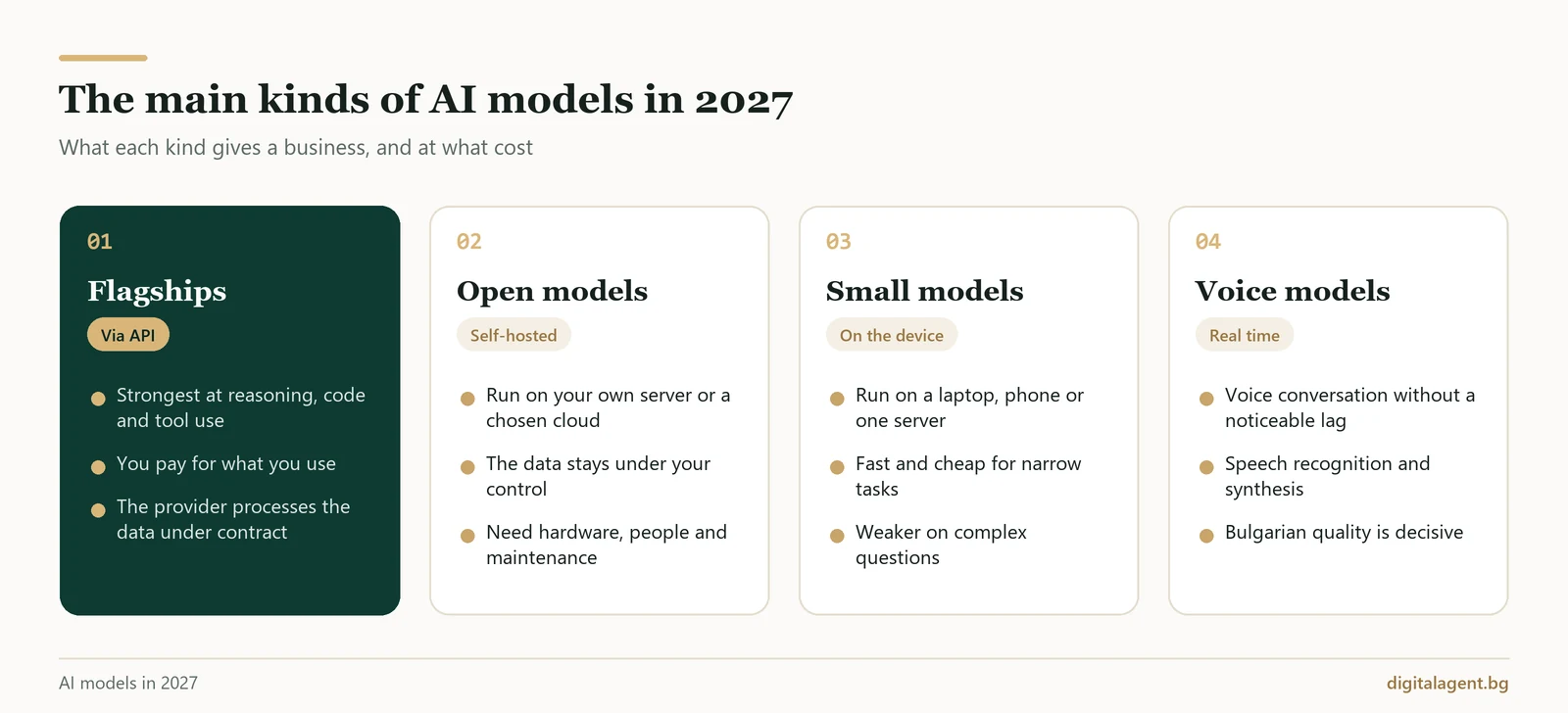
In September and October 2026 alone, eight companies released new models, so it is more useful to know the types of model than the individual names:
- Flagships via API (GPT-6 Astra, Claude Fable 5.1 and Opus 5.5, Gemini 4 Argon, Muse Wonder): for complex and long tasks, but at the highest price, and the data passes through the provider.
- Mid-priced models via API (GPT-6.1 Sol, Claude Sonnet 5.5, Gemini 3.8 Flash): for everyday customer service at high volume.
- Large models with open weights, known as open-weight models (MiMo-V2.6-Pro, DeepSeek V4.1 Flash, GLM-5.3, Kimi K3): on your own server, which requires expensive hardware, or cheaply via a third-party API.
- Small models (Gemma 4, Qwen3.8-27B, BgGPT 3.0): on a single computer, laptop or phone, but weaker at complex tasks.
- Voice models (GPT-Live 1, Gemini 3.8 Live, Voxtral 3): for real-time conversations, with uneven support for Bulgarian.
The flagships at the end of 2026: GPT-6, Claude 5.5, Gemini 4 Argon and the rest
Prices in the table are in US dollars per million tokens (a token is part of a word), taken from the official price lists of OpenAI, Anthropic, Google and xAI as of 27 October 2026. Points are from the Artificial Analysis index as of the same date.
| Model | Company | Released in 2026 | Price, input / output | Note |
|---|---|---|---|---|
| GPT-6 Astra | OpenAI | 3.09 | 10 / 50 $ | OpenAI's flagship; 53 points |
| GPT-6.1 Sol | OpenAI | 29.09 | 2 / 10 $ | 52 points |
| GPT-6.1 Terra | OpenAI | 26.10 | 1 / 5 $ | Visual reasoning, computer use, writing |
| Claude Fable 5.1 | Anthropic | 1.09 | 10 / 50 $ | For the hardest tasks; 53 points |
| Claude Opus 5.5 | Anthropic | 22.09 | 4 / 20 $ | The default choice according to Anthropic; 58 points, first place |
| Claude Sonnet 5.5 | Anthropic | 28.09 | 2 / 10 $ | 56 points |
| Claude Haiku 5.5 | Anthropic | 7.10 | from $0.10 / $0.50 | For high volume |
| Gemini 4 Argon | 13.10 | $2 / $10 until 30 Nov, then $4 / $20 | Google's most capable model; 53 points | |
| Grok 4.7 | xAI | September | 2 / 6 $ | – |
| Muse Wonder | Meta | 12.10 | – | 52 points; Muse Wonder Full – 56 points |
| Kimi K3.1 Pro | Moonshot | 23.10 | – | 55 points |
The European alternative is Mistral Large 4, released on 6 October as a public preview.
Almost all the flagships are models with extended reasoning: they work through a task in several steps, so they are more accurate on complex cases but use more tokens. The rankings change every week and do not show how a model will cope with your data.
Open-weight and open-source models: who leads and what the licence allows
Open-weight (a model with open weights) means that the developer publishes the trained model, and you can download it and run it wherever you like. Open source in the strict sense goes further: the code and information about the training data are open as well. Self-hosted means that the model runs on your own server or in a cloud you rent, rather than at a provider to which you send text via an API. The “open source” label is often applied to models with a restricted licence too, so the licence is what decides.
As of 27 October 2026, the Artificial Analysis ranking for open-weight models is led by Xiaomi's MiMo-V2.6-Pro (46 points), followed by DeepSeek V4.1 Flash and Z.ai's GLM-5.3 (45 points each). According to media reports, Moonshot has promised to release the weights of Kimi K3.1 Pro (55 points) by 4 November, which would narrow the gap with the best closed model in the index from 12 points to 3. According to Epoch AI , between January and May 2026 open models lagged behind closed ones by about 4 months on average, and after the autumn flagships the best open model in the Epoch index, Kimi K3, is at the level of closed models from February–March 2026.
Licences fall into three groups. MIT and Apache 2.0 allow commercial use with almost no conditions. The custom licences of GLM-5.3, Kimi K3 and Muse Spark Open impose conditions only if a company offers the model as a service and its revenue over 12 months exceeds the threshold: for GLM-5.3 this triggers a security review by Z.ai, and for the other two a separate agreement is required; Muse Spark Open also always requires the notice “Built with Muse Spark Open”. Restrictions apply to BgGPT 3.0 (the Gemma terms of use) and to the multimodal Llama 4 models, which are not licensed for companies headquartered in the EU.
The main open-weight models as of 27 October 2026:
| Model | Company | Artificial Analysis points | Licence | Hardware for your own server | Bulgarian |
|---|---|---|---|---|---|
| MiMo-V2.6-Pro | Xiaomi | 46 | MIT | Usually several accelerators | Only English and Chinese listed |
| DeepSeek V4.1 Flash | DeepSeek | 45 | MIT | Usually several accelerators | Test it |
| GLM-5.3 | Z.ai | 45 | Custom, $10 billion threshold | Several accelerators; 753 billion parameters | Only English and Chinese listed |
| Muse Spark Open | Meta | 39 | Custom, $20 million threshold, mandatory notice | At least 700 GB of video memory (NVFP4) or two Mac Studio M5 Ultra machines | Over 100 languages; Bulgarian not listed |
| Kimi K3 | Moonshot | – | Custom, $20 million threshold | Many accelerators; 2.8 trillion parameters | Languages not listed |
| Qwen3.8-27B | Alibaba | 34 | Apache 2.0 | 24–32 GB graphics card | Test it |
| gpt-oss-120b | OpenAI | – | Apache 2.0 | 96–512 GB workstation | Test it |
| Gemma 4 31B | – | Apache 2.0 | 24–32 GB graphics card | Test it | |
| BgGPT 3.0 27B | INSAIT | – | Gemma terms | 24–32 GB graphics card | Specialised |
A dash means that, as of 27 October 2026, the model has no score in this Artificial Analysis ranking.
Local (self-hosted) AI model: when it pays off, what hardware you need and what it costs
Your own model gives you two things: the data stays in your infrastructure, and the bill does not grow with every token. You pay for hardware, electricity, maintenance and staff.
As a rough guide, a model takes 2 bytes of memory per parameter in 16-bit format (BF16), 1 byte in 8-bit format and half a byte with 4-bit compression, plus headroom for the context. According to Meta, Muse Spark Open (816 billion parameters) needs at least 700 GB of video memory in the 4-bit NVFP4 format and 2 TB in BF16. This gives three tiers:
- A computer with a 24–32 GB graphics card or a Mac with at least 32 GB of memory: models with 20–35 billion parameters in compressed form, such as Qwen3.8-27B, Gemma 4 31B or BgGPT 3.0 27B.
- A workstation with 96–512 GB of memory: models of up to about 120 billion parameters, such as gpt-oss-120b. According to published 2026 prices, the NVIDIA DGX Spark costs $4,699, the Mac Studio M5 Ultra from $5,499, and the RTX PRO 6000 Blackwell graphics card around $12,000–14,500.
- A server with eight or more accelerators (specialised AI graphics cards such as the NVIDIA H200 or B300): usually for the large open-weight models. By our calculation, Muse Spark Open in NVFP4 fits on eight H200s (141 GB of memory each), and according to Meta it also runs on two Mac Studios with M5 Ultra.
As of October 2026, renting a single H200 accelerator from specialised cloud providers such as RunPod, Nebius and CoreWeave costs about $3.6–6.3 per hour. By our calculation, renting just eight H200s running round the clock comes to about $21,000–37,000 a month, excluding maintenance, staff and testing with every new generation of models.
In our view, for most small and medium-sized businesses your own model makes sense when a contract or the law forbids data from leaving the company, when you have a steady volume of millions of tokens a day, or when you need to work without an internet connection. In other cases an API, including one for an open model, is cheaper and simpler. If you are not sure, start with an API and move to your own server when volume or data requirements make it necessary.
AI in Bulgarian, data and the rules in the EU
For Bulgarian, the specialised option is BgGPT 3.0. In March 2026 INSAIT unveiled three open models with 4, 12 and 27 billion parameters, built on Google's Gemma 3 and further trained on over 100 billion words of Bulgarian. According to INSAIT, the 27-billion-parameter model outperforms Qwen 3 32B and the almost nine times larger Qwen 3 235B, both 2025 models, in Bulgarian and English on the aggregate score across four benchmarks. As of October 2026, the institute has not published a comparison with current models.
EuroLLM-22B and Mistral Large 4 explicitly cover all official EU languages, whereas the official descriptions of GLM-5.3 and MiMo-V2.6-Pro list only English and Chinese. We found no independent ranking of current models in Bulgarian, so put the same real questions from your customers to several models and compare accuracy, tone, grammar and how often each model makes up facts.
According to the European Commission's page on the Artificial Intelligence Act (AI Act) , most of the regulation applies from 2 August 2026, including the transparency rules: people must know that they are talking to an AI system, such as a chatbot or a voice agent. Obligations for the high-risk systems in Annex III have been postponed to 2 December 2027.
For personal data sent to a model via an API, you need a data processing agreement under Article 28 of the GDPR. As of October 2026, OpenAI offers processing in a European region subject to approval and at a 10% higher price, while with Gemini 4 Argon in Google Cloud the data is guaranteed to be processed in the EU only if you use the service's European address (endpoint). Anthropic's direct API processes data either globally or only in the US, and EU processing for Claude is available through Amazon Bedrock or Google Cloud.
Small and voice models: on-device AI and AI voice in Bulgarian
In April 2025 Gartner predicted that by 2027 organisations will use small, task-specific models at least three times more than large general-purpose ones. Google's Gemma 4 has small versions for phones and laptops, while Qwen3.8-27B and Meta's Muse Glimmer (August, Apache 2.0) run on a single graphics card.
In 2026, models for phone agents arrived that listen and speak at the same time and react immediately when the other person interrupts them: OpenAI's GPT-Live 1 (from 10 September), Google's Gemini 3.8 Live (from 15 September) and xAI's Grok Voice 3.0 (October, $0.08 per minute). Mistral's Voxtral 3 (20 October) can also run on your own infrastructure. Bulgarian is explicitly listed in the documentation for the Gemini Live API, Gemini 3.8 Flash TTS and ElevenLabs' Eleven v4, and Voxtral 3 includes it in its transcription benchmarks but not in speech synthesis. We found no independent measurements of the quality of Bulgarian speech. OpenAI's older voice models, such as gpt-realtime, will be retired on 20 January 2027.
Our AI voice agent in Bulgarian handles real phone calls with Bulgarian voices, records them and keeps the full transcript and a summary of every call.
How to choose an AI model for your company: API flagship or your own model
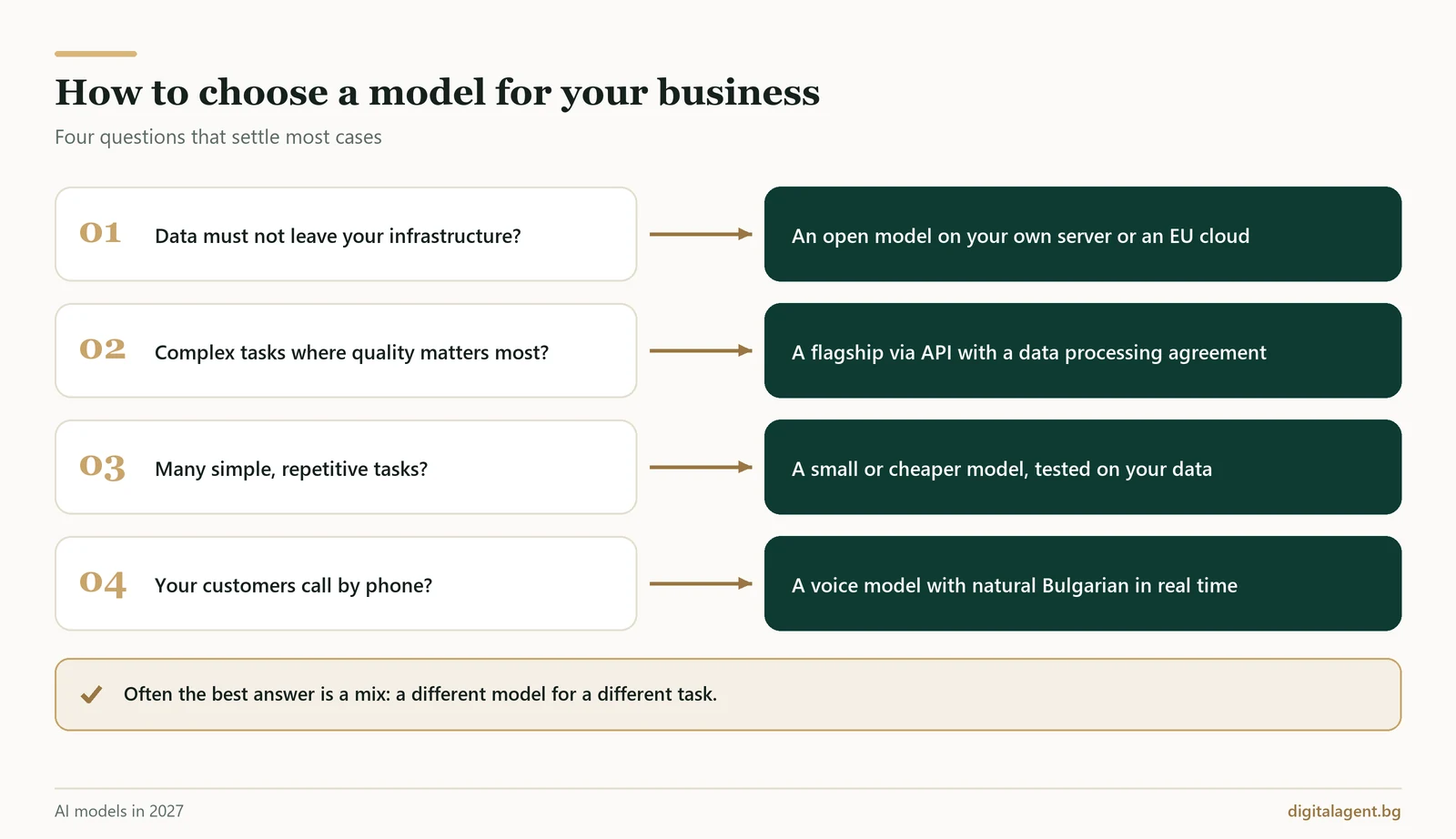
The two routes compared on the main criteria:
- Quality on complex tasks: highest with models via API; open models lag a few months behind, according to Epoch AI.
- Bulgarian language: in both cases you need to test it; for your own server there is the specialised BgGPT 3.0.
- Data: via API it passes through the provider, and only some providers offer EU processing; on your own server it stays with you.
- Costs: with an API there is almost no upfront cost, but you pay for every token; your own model costs anything from a single computer to a six-figure sum, plus electricity, maintenance and staff.
- Licence and updates: with an API the terms are set by the provider, which also changes and retires models; with your own model its licence applies, and you decide when to update.
Add two more questions. The first is the cost per conversation, not per token: an agent that reasons and uses tools consumes far more tokens than a simple chat. An illustrative example: with roughly 20,000 input and 2,000 output tokens in total, a conversation costs about $0.06 on a $2 / $10 model such as Claude Sonnet 5.5 or GPT-6.1 Sol, and about $0.30 on a $10 / $50 flagship. At 3,000 conversations a month, that is about $180 versus $900. The second question is how easily you can switch models when a better one comes out.
An agent in your website chat, on the phone, in WhatsApp and Viber most often answers questions about prices, availability and opening hours, which rarely call for the most expensive flagship. That is why, when setting up each of our AI agents, we choose the model to suit the tasks and the budget. There is more in our articles on AI agent for customer support, how much an AI agent costs in Bulgaria and implementing AI in 7 steps.
What to expect in 2027
As of 27 October 2026, the remaining Gemini 4 models are still to come with no announced dates, Alibaba said on 22 September that Qwen 4 is “in training”, and there are no dates for GPT-7 or Claude 6. In the EU, from 12 January 2027 cloud providers will no longer be able to charge for switching provider under the Data Act.
Trends and forecasts are less certain. According to 2025 data from Epoch AI, the price of a given level of quality falls by a factor of between 9 and 900 a year depending on the task, but the authors are not sure that the pace will hold. According to a Gartner forecast from June 2025, over 40% of AI agent projects will be cancelled by the end of 2027 because of costs, unclear value or weak risk controls; this is an expectation, not a fact.
Our advice for 2027: choose the task and the criteria first, then the model, and plan to switch models at least once a year. We cover the longer horizon in the article how AI will change business by 2030.
Frequently Asked Questions
Which is the best AI model right now?
Which is the best open-source (open-weight) AI model right now?
Which AI model works best in Bulgarian?
What is a local AI model and what computer do I need for it?
Can I use an open-source AI model for commercial purposes?
Is it safe to enter company data into ChatGPT, Claude or Gemini?
If you would like to see how an AI agent would work with your tasks and data, book a free consultation. We will review the processes you want to automate and your data requirements, assess what is suitable and show you how an AI agent can take over your first process.
Digital Agent (AI AVTOMATIZATSII OOD) is a specialist agency for AI automation, AI agents and integrations. We build practical, durable solutions for hotels, restaurants, online shops and B2B companies in Bulgaria, Greece and Romania.