AI for lawyers and law firms is already speeding up searches for legislation and case law, summaries, translations, document comparison, first drafts and client correspondence, while legal AI tools for Bulgarian law such as Ciela-Noxtua, ApisGPT, Praven Intelekt, Decimo and Magistrat cost from about €8 to €130 a month with annual billing. The basic rule: AI does not give legal advice, and everything it produces is checked before use by the lawyer who is responsible for it.
The information in this article was checked on 6 November 2026.
This article is not legal advice, and the information comes from the official sources cited. At Digital Agent we build AI agents, and at the end we show an example from a real law firm.
What AI can do for lawyers today and how much time it saves
In Bulgaria, artificial intelligence for lawyers is already widespread: according to the Supreme Bar Council survey of October 2026, 75.49% of the lawyers who responded use AI tools, most often for legal research (73.19%), searching case law (68.54%) and translation (53.80%). In Wolters Kluwer's March 2026 survey of 810 lawyers from the US, China and nine European countries, 62% reported saving 6–20% of their working week, or 2.4 to 8 hours in a 40-hour week.
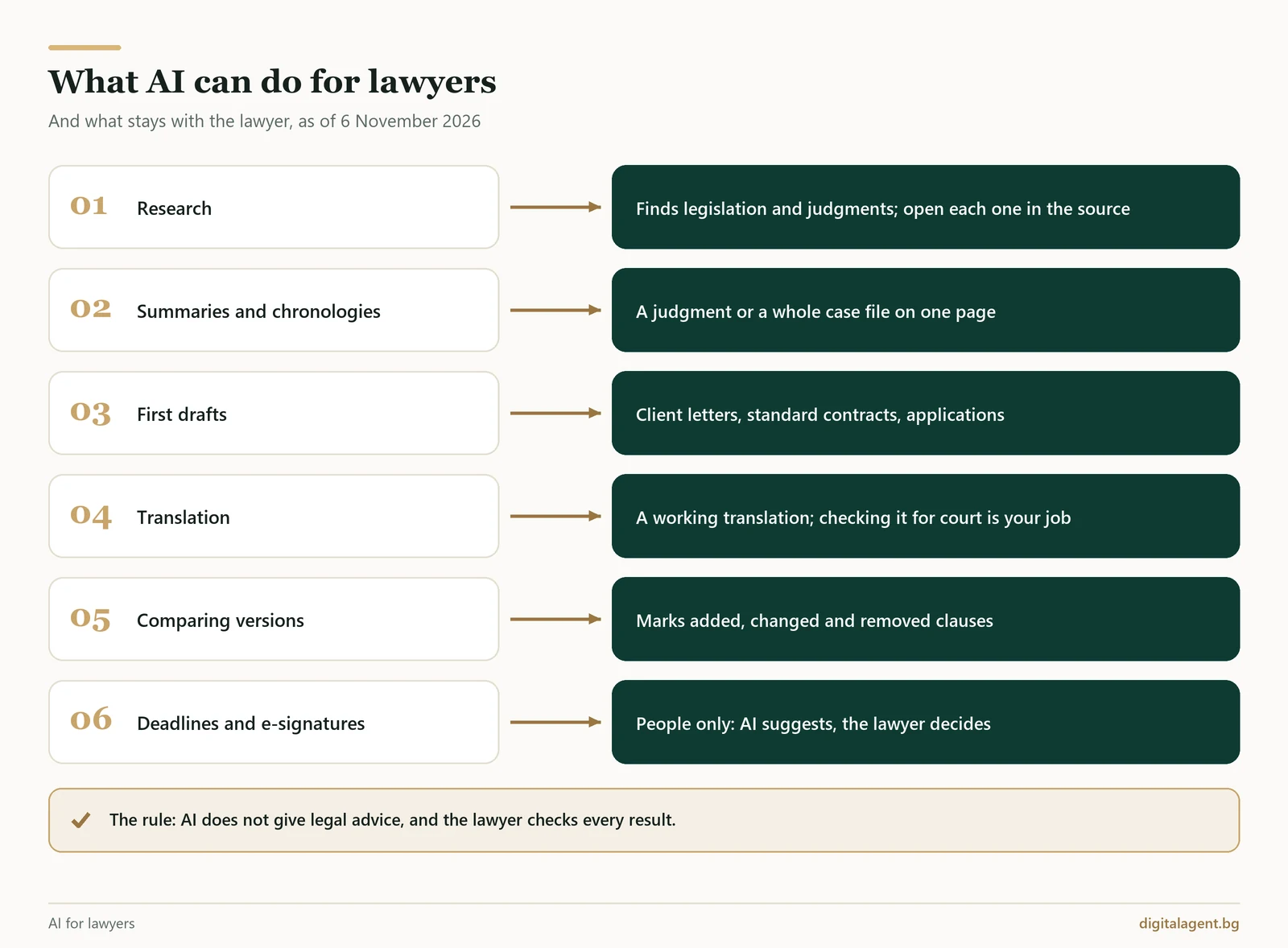
Research. AI finds the applicable provisions and judgments and arranges them around your question, and you open each judgment in the original source.
Summaries and chronologies. A long judgment or an entire case file is boiled down to a single page of facts, dates and references to the pages of the original.
First drafts. A letter to a client, a contract based on a template or an application starts from a draft, while the arguments remain yours.
Translation. AI produces working translations from and into English, Turkish, Greek and other languages. In court, however, the translation is certified by the party (Article 185 of the Civil Procedure Code), so checking it is up to you.
Comparison and old archives. AI compares versions of a contract, flags the changed clauses and makes scanned documents searchable. Text recognition (OCR) is already used by 46.55% of the survey respondents.
Clients and case management. AI prepares replies in the client's language and sorts documents by client and case. We give an example from a real law firm below; there, deadline suggestions that a person confirms are part of the agreed second stage.
What AI should not do: fabricated case law and sanctions
AI should not give legal advice without a lawyer, cite judgments that nobody has checked, or sign and file documents and set deadlines without human confirmation. The most visible mistake so far has been fabricated citations: as of 5 November 2026, Damien Charlotin's database records 2,266 court decisions worldwide dealing with AI-fabricated content, 898 of them involving lawyers, and none from Bulgaria. Sanctions are mounting:
- US, 22 June 2023. A federal court in New York (Mata v. Avianca) fined two lawyers and their firm $5,000 over judgments invented by ChatGPT.
- England, 6 June 2025. The High Court (Ayinde v Haringey) found that freely available AI tools are not capable of reliable legal research and referred the lawyers involved to their regulators.
- Spain, 10 February 2026. The High Court of Justice of the Canary Islands fined the lawyer €420 personally. The citations came from a paid AI tool.
- Italy, 12 May 2026. The Court of Appeal in Bologna ordered the lawyer's clients to pay a total of €5,000 and stated that generative models are not case-law databases.
In Bulgaria, the general rules are enough on their own: under Article 132 of the Bar Act, systematic negligence and manifest ignorance are disciplinary offences, and the penalties under Article 133 go as far as losing the right to practise law.
Client confidentiality and GDPR: what you can upload to AI, and where
A lawyer is “obliged to keep their client's secrets without limitation in time” (Article 45 of the Bar Act), and the Code of Ethics (Article 5(3)) requires anyone the lawyer works with to maintain confidentiality too. The Supreme Bar Council survey shows where the risk lies: 46.30% of respondents use only free versions, and 10.50% upload client documents without anonymising them.
Personal account: no client data. In personal ChatGPT and Gemini accounts, conversations may be used for training by default unless you switch this off, while in Claude it depends on the choice you make. We describe the settings in ChatGPT in Bulgarian: plans and data settings and Claude in Bulgarian: plans and privacy.
Business subscription: a contract and no training. On business subscriptions from OpenAI, Anthropic, Google and Microsoft, data is not used for training by default, and the provider signs a data processing agreement under Article 28 of the GDPR. For Google, see Gemini in Gmail, Docs and Google Workspace.
Data in the EU. The legal tools in the table below state that their servers are in the EU or Switzerland, but according to its own policy Magistrat also sends the text of questions to providers in the US, so read the list of sub-processors. In Microsoft 365 Copilot, Claude models are for now outside the EU Data Boundary and are switched off by default in the EU.
Safeguards. The Council of Bars and Law Societies of Europe (CCBE) guide of 2 October 2025 allows client data to be used in AI only with safeguards: contractual confidentiality or zero data retention, a contract that limits use to the firm's purposes, or AI under the firm's own control. Its technical guide of 27 March 2026 points to the firm's own server as the most secure option for confidentiality and warns that a provider may be compelled to hand over data. See when a local (self-hosted) AI model is worth it.
The EU AI Act and the legal profession: what applies to a law firm as of November 2026
AI literacy (Article 4), from 2 February 2025. Under the AI Act, a law firm whose people use AI must take measures to ensure their AI literacy, and since the July 2026 amendment no particular level is required. According to the European Commission's answers of 20 October 2026, no certificate is needed, training can be documented in an internal record, and anyone who writes or translates with ChatGPT needs to know about the risk of fabricated answers. National authorities have been supervising compliance since 2 August 2026.
Transparency (Article 50), from 2 August 2026. If a chat bot or voice agent talks to clients, it must be clear to them that they are dealing with AI, unless this is obvious. The CCBE recommends telling clients about the use of AI if an informed client would object or attach conditions.
High-risk AI. Annex III, point 8 concerns AI used by courts and by alternative dispute resolution bodies, not a law firm's everyday tools, and applies from 2 December 2027.
Bulgaria. There is no national law implementing the regulation yet, and the Supreme Bar Council has not yet adopted any rules: in June 2026 it put a draft new section of the Code of Ethics out to public consultation (checking every AI output, protecting confidentiality, labelling automated legal answers that no lawyer has approved), and earlier it published a translation of the guidelines of the International Association of Lawyers (UIA). At the national conference in Ruse on 31 October 2026, attended by more than 150 lawyers, the prevailing view favoured minimal additions to the code, regularly updated guidance and training.
General AI assistant or legal AI in Bulgarian: differences and prices
General assistants such as ChatGPT, Claude and Gemini work in Bulgarian and are well suited to language work: summaries, editing, letters to clients. For a legal provision or a judgment, rely only on a source you have opened yourself. Legal tools answer from their own database of legislation and case law and link to the source. As of November 2026, the following providers offer AI for lawyers with a database of Bulgarian legislation and case law:
| Tool | What it offers | Data | Price and trial access |
|---|---|---|---|
| Ciela-Noxtua (Ciela Norma), since 4 November 2026 | Research with citations, document comparison, draft statements of claim and contracts, a workspace for each case | Germany and Switzerland | €1,060 a year or €105 a month excluding VAT, with the Ciela databases included |
| ApisGPT (APIS) | Answers and analysis based on Apis Pravo, Apis Praktika and Evro Pravo, with references to the source | Stored in the EU, no training, optional anonymisation | €850 a year with the databases, or €360 if you have an active subscription to them, excluding VAT; 24 hours free |
| Praven Intelekt (part of Lexroom since September 2026) | Research into legislation and case law, document drafts | Germany, France and Sweden, no training | €35.99–129.99 a month excluding VAT with annual billing; 7 days of Premium with a card, then €124.99 a month |
| Decimo | Research with citations, analysis and editing of Word, PDF and scanned documents | EU, no training | €25.49–93.49 a month excluding VAT with annual billing; 14 days without a card |
| Magistrat | Answers based on current legislation, case law of the Supreme Court of Cassation and the Supreme Administrative Court, the e-Justice Portal and 39 registers, a Word add-in | Hosted in Germany, no training; the text of questions is also processed by OpenAI and by a search provider, including in the US | €9.99 a month or €99.90 a year, larger plans from €41.99 a month, including VAT; 2 questions a week without registration |
Prices are taken from the official pages and price lists as of 6 November 2026, and the ApisGPT trial access from the APIS presentation of 15 July 2026. We have not tested the tools: the descriptions are the providers' own.
“Software for lawyers” usually means case management software that keeps track of cases and deadlines. AI case management connects the cases with the archive and with client correspondence.
The e-Justice Portal, e-signatures and deadlines: what is specific to Bulgaria
The language of the courts is Bulgarian (Article 4 of the Civil Procedure Code), and more and more work goes through the Unified e-Justice Portal (EPEP).
Access to cases. On 27 May 2026, the e-Justice Portal gave every lawyer with a qualified electronic signature access even to electronic cases they are not involved in, with every viewing recorded in a log, but by decisions of 11 June 2026 the Supreme Judicial Council instructed the courts to restrict access to cases in which the lawyer does not represent a party. As of November 2026, practice varies from court to court. Documents in the portal contain personal data, so the confidentiality rules apply in AI tools too.
Deadlines. When documents are served through the e-Justice Portal, a notice that you do not download within 7 days of it being sent is deemed served on the first day after that period ends (Article 41a of the Civil Procedure Code). AI can send reminders, but a person confirms the deadline.
Administrative cases. Following the amendments to the Administrative Procedure Code from 1 July 2026, administrative courts accept electronic procedural steps through the e-Justice Portal or the Secure Electronic Service System.
The e-signature stays with the lawyer. Electronic submissions to the court that require a signature are signed with a qualified electronic signature (Article 102zh of the Civil Procedure Code): AI prepares the document, but signing it is the lawyer's decision.
How to start safely: a checklist for your firm
AI in a law firm starts with a few rules:
- One task with no client data: a summary of a published judgment or a translation of a piece of legislation.
- A written policy on which tools are permitted and what must not be uploaded to them.
- A business subscription or a legal tool with a data processing agreement, no training and a clear statement of where the data is processed.
- Anonymisation of names, personal ID numbers, addresses, case numbers and account numbers before uploading; initials are not enough if the person can still be identified from the other details.
- Checking every citation at the source: a judgment you cannot find does not go into the document.
- Deadlines and signatures by people only: AI suggests the deadline, a member of staff confirms it, and the lawyer signs with a qualified electronic signature.
- Training and an internal record covering the risk of fabricated answers, under Article 4 of the AI Act.
- Insurance and clients: check whether your insurance covers work with AI, as the UIA recommends, and tell clients when AI is answering them.
Ready-made prompts for lawyers and four little-known features
These prompts are meant for a business subscription or a legal tool that does not train on your data. Do not paste client data into a personal account, and replace names and numbers with [Client A] and [case no.].
| Task | Prompt to copy |
|---|---|
| Summary of a judgment | “Summarise the attached judgment in 8 points: parties, subject matter, claims, facts, legal conclusions, operative part, time limit for appeal and appeal procedure. For each point, give the page number, and mark anything missing as not stated.” |
| Case chronology | “Make a table from the attached documents: date, event, document, page. Sort it by date and flag any discrepancies between the documents.” |
| Contract risks | “Review the contract as counsel for [party]. Table: clause, risk, proposed new wording. If you are not sure about a legal provision, flag it for checking instead of citing it.” |
| Comparing two versions | “Compare version 1 and version 2 of the contract. List every added, amended and deleted clause with its number and how it changes the position of [party].” |
| Letter to a client | “Write a short letter to the client in [Turkish] in plain language: what has happened in the case, what happens next and what they need to bring. No legal advice and no dates other than those in my text. Add a Bulgarian translation so I can check it.” |
| Citations to check | “List in a table every piece of legislation, article and court decision cited in the text below, and what the text says about each one. Do not assess whether they exist; I will check them at the source.” |
Four lesser-known features:
- Magistrat checks its citations. A citation that is found in the database and says exactly what is claimed is marked “Verified”, while an article that does not support the statement is marked “Unconfirmed”; a statement without a source is sent back for correction before the answer reaches you (as of 6 November 2026).
- ApisGPT anonymises before sending. Under “Settings” → “Data control”, you can switch on anonymisation of names, personal ID numbers and bank details and choose how long your history is kept. APIS warns that anonymisation is not absolute (15 July 2026).
- Thumbs feedback in ChatGPT overrides your training opt-out. In a personal account, rating a reply with a thumbs up or thumbs down allows OpenAI to use the whole conversation for training, even if the setting is switched off (October 2026).
- Advertising with AI-written text. Since the amendment to the Bar Act in State Gazette No. 17 of 2026, lawyers may advertise, but without false information or unjustified expectations, and may use details of clients and cases only with their written consent (Article 42). Check every AI-written text for your website against these rules.
What we can build for your law firm with AI
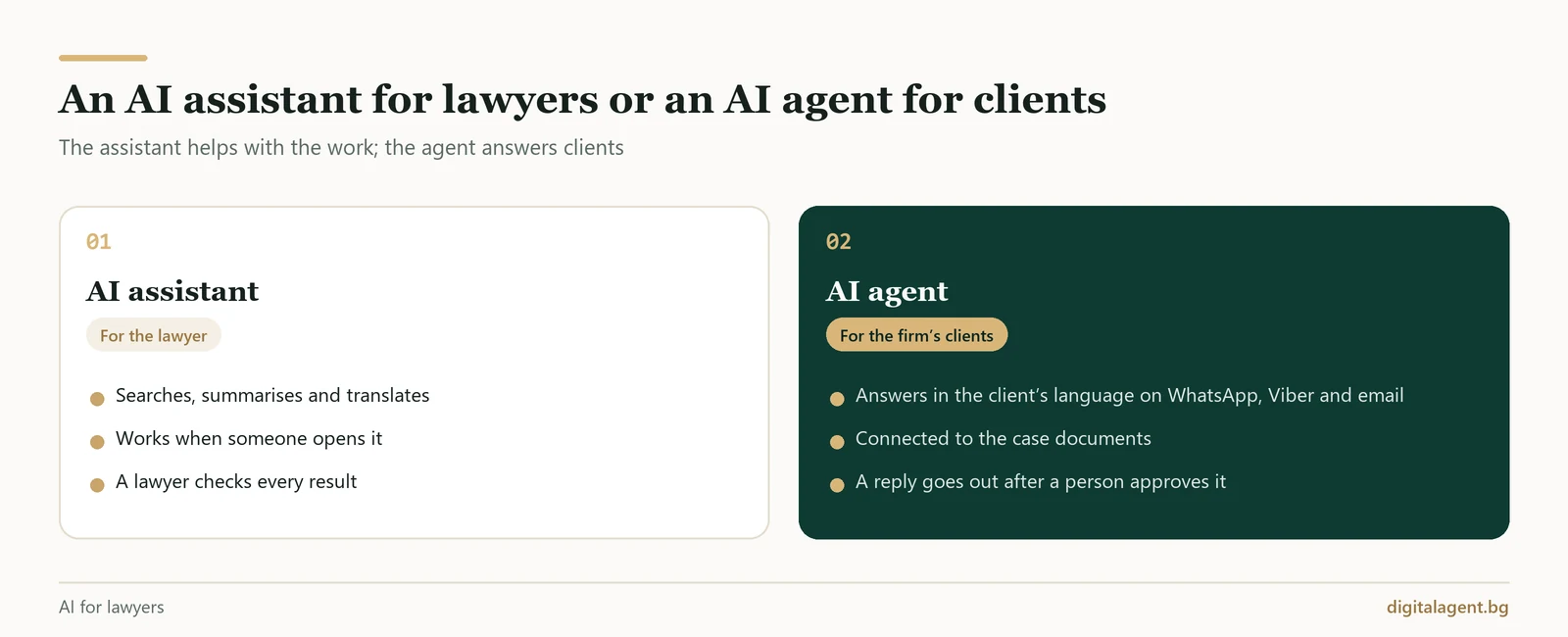
Assistants work for the lawyer, but a client who writes on WhatsApp in the evening, or calls while the lawyer is in court, needs an AI agent connected to the firm's documents and rules, as we explained in the article What is an AI agent and how does it differ from an assistant and a chat bot.
An example from practice: at a firm handling immigration law, citizenship and company matters, clients write on WhatsApp and by email in Turkish, English, Greek and Bulgarian. The AI agent prepares draft replies in the client's language, and every reply goes out only after a person at the firm has approved it. Each client sees only their own case, and when the agent is not sure, it stays silent and passes the conversation to a person. About 41,000 documents (38 GB) are sorted by client and case, about 15,000 scanned documents have become searchable, and the archive is kept in the EU. The agreed second stage adds types of proceedings, deadline suggestions that only count once a person confirms them, template documents, and signing with a qualified electronic signature only when the lawyer confirms it.
We told the whole story in AI case management for a law firm: a case study, and more case studies of AI agents at work on a separate page. For law firms, we also build:
- An AI chat agent on your website. It answers first questions about the firm's rules and fees and guides the visitor towards booking a consultation, without giving legal advice.
- An AI voice agent that answers the firm's phone. It speaks natural Bulgarian on a real phone line and replies in about a second on average, and when a call is transferred, the member of staff sees who is calling and what they want.
- An agent in Viber and WhatsApp. It replies on the firm's behalf where clients already write, and a member of staff can take over the conversation at any time.
- AI automation for documents and email. Scanned archives become searchable, and a letter from a public authority does not get lost among the newsletters.
Indicative prices excluding VAT: an AI chat agent from €1,000 for implementation and from €120 a month; an AI voice agent €1,500–3,000 one-off, €170 a month and €0.21 per minute.
Frequently Asked Questions
Which AI assistant is best for Bulgarian law?
Is there free AI for lawyers in Bulgarian?
Can a lawyer upload case documents to ChatGPT?
Is client confidentiality protected in a conversation with AI?
What does the EU AI Act require of law firms?
How much do legal AI tools in Bulgarian cost?
If you run a law firm and want your clients to get a quick reply without putting confidentiality or deadlines at risk, book a free consultation: we will choose one process, such as client questions on WhatsApp or the firm's phone, and on request we will show you AI case management with sample data.
Digital Agent (AI AVTOMATIZATSII OOD) is a specialist agency for AI automation, AI agents and integrations. We build practical, durable solutions for hotels, restaurants, online shops and B2B companies in Bulgaria, Greece and Romania.